
Is Your Cat’s Water Fountain Actually a Bacteria Hotel? (Stainless Steel vs. Plastic)
We’ve all been there: It’s 3 AM, the house is silent, and suddenly you hear it—that annoying, low-frequency BZZZZZ coming from the kitchen. You walk in, and there’s your cat, staring at a plastic fountain that sounds more like a struggling old refrigerator than a fresh mountain stream.
As a cat parent, you bought that fountain to keep them hydrated. But if you’re using a plastic one, you might be giving them more than just water. You might be serving up a cocktail of bacteria.
After a decade in the pet industry, I’ve seen thousands of fountains. Here is the “gross” truth about why the material of your fountain is the most important health decision you’ll make for your cat this year.
1. The “Slimy Film” Mystery (And the Napkin Test)
Have you ever scrubbed your cat’s plastic fountain and felt that slippery, transparent “slime” on the walls?
That’s not just “old water.” That is a Biofilm—a complex colony of bacteria that bonds to the surface of the plastic.
Try the Napkin Test: Even if your plastic fountain looks clean, take a white paper towel and wipe the inner corner with some pressure. See that faint pink or yellowish stain? That’s Serratia marcescens, a bacteria that thrives in the microscopic scratches caused by your cleaning brush. Because plastic is soft, it develops thousands of tiny “canyons” where bacteria hide, breed, and wait for your cat’s next sip.
2. “Poppy Seeds” on the Chin: The Feline Acne Link
If your cat has tiny black specks on their chin that look like poppy seeds, they aren’t dirty—they have Feline Acne.
Think of it this way: drinking from a scratched plastic fountain is like washing your face every day with a kitchen sponge that’s been sitting in a damp basement for a month. Every time your cat’s chin touches that bacteria-laden plastic, their pores get clogged.
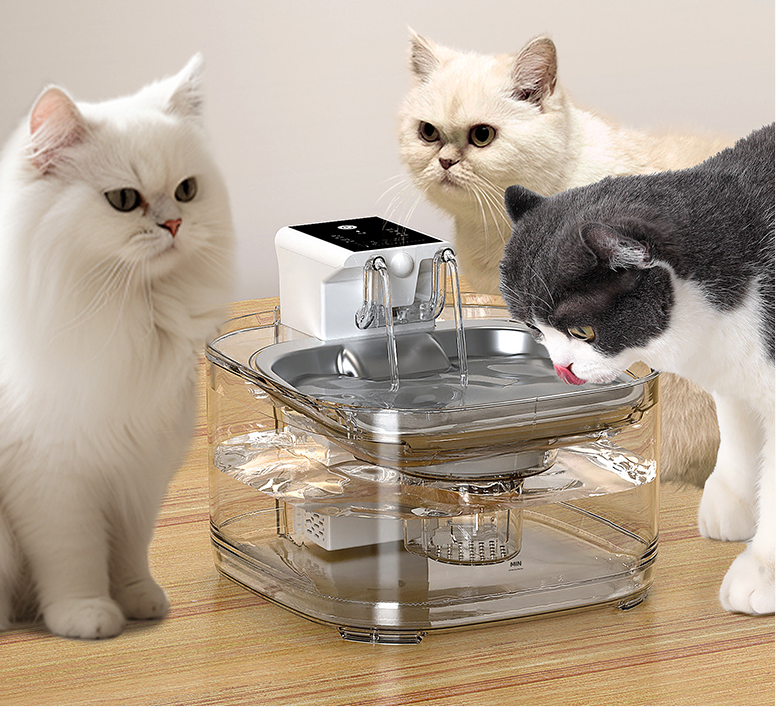
The Expert’s Secret: In my 10+ years of experience, the #1 “cure” for cat acne isn’t expensive medicine—it’s throwing away the plastic bowl and switching to Non-Porous 304 Stainless Steel.Wireless 3.2L Stainless Steel Cat Water Fountain – 5000mAh, 4‑Stage Filter_Pet Super Factory
3. Why 304 Stainless Steel is the “Gold Standard”
In professional kitchens and surgery rooms, we use 304 stainless steel. Why? Because bacteria can’t find a “foothold” on its mirror-smooth surface.
- No Hiding Spots: Unlike plastic, 304 steel is “non-porous.” Bacteria can’t burrow into it. A simple rinse actually works.
- The “Forever” Material: Plastic becomes brittle, stains, and eventually leaches chemicals like BPA. Our 304 steel stays as pristine on day 1,000 as it was on day 1.
- Dishwasher Hero: You can toss our steel fountain in the dishwasher at high heat to truly sterilize it. Try that with plastic, and you’ll end up with a warped, toxic mess.
4. The Sound of Silence: Bubbling Brook vs. Buzzing Fridge
One of the most common complaints I hear is: “My fountain is so loud it scares my cat.”
Here’s an industry insider tip: Plastic vibrates; Steel absorbs.
Plastic is thin and lightweight, acting like a megaphone that amplifies the pump’s vibration into a loud “hum.”
Our stainless steel fountain is designed with a high-density base that grounds the vibration. Instead of a mechanical buzz, you get the gentle, rhythmic sound of water breaking the surface. It’s the difference between a construction site and a spa—perfect for “light sleepers” (both humans and cats).
5. Comparison: The Honest Truth
| The Experience | Plastic Fountains | Our 304 Stainless Steel |
| The “Feel” | Slime builds up in 48 hours | Stays “squeaky clean” longer |
| The Sound | Constant “BZZZ” vibration | Whisper-quiet (under 30dB) |
| Health | Can cause “Black Chin” (Acne) | Vet-recommended for skin health |
| Durability | Scratches, cracks, and stains | Rust-proof, scratch-resistant |
The Bottom Line: Don’t Save Pennies on a Plastic Bowl
You might save $10 today by buying a plastic fountain, but you’ll spend $100 later at the vet treating a skin infection or a urinary issue because your cat hated the “plastic taste” of the water.
Switching to a Stainless Steel Fountain is a small change that makes a massive impact. Your cat gets water that tastes like it came from a glass; you get a kitchen that finally sounds quiet.
Contact us for our 2026 latest Stainless Steel Water Fountain.